
Aluminium oxide abrasives
White fused alumina
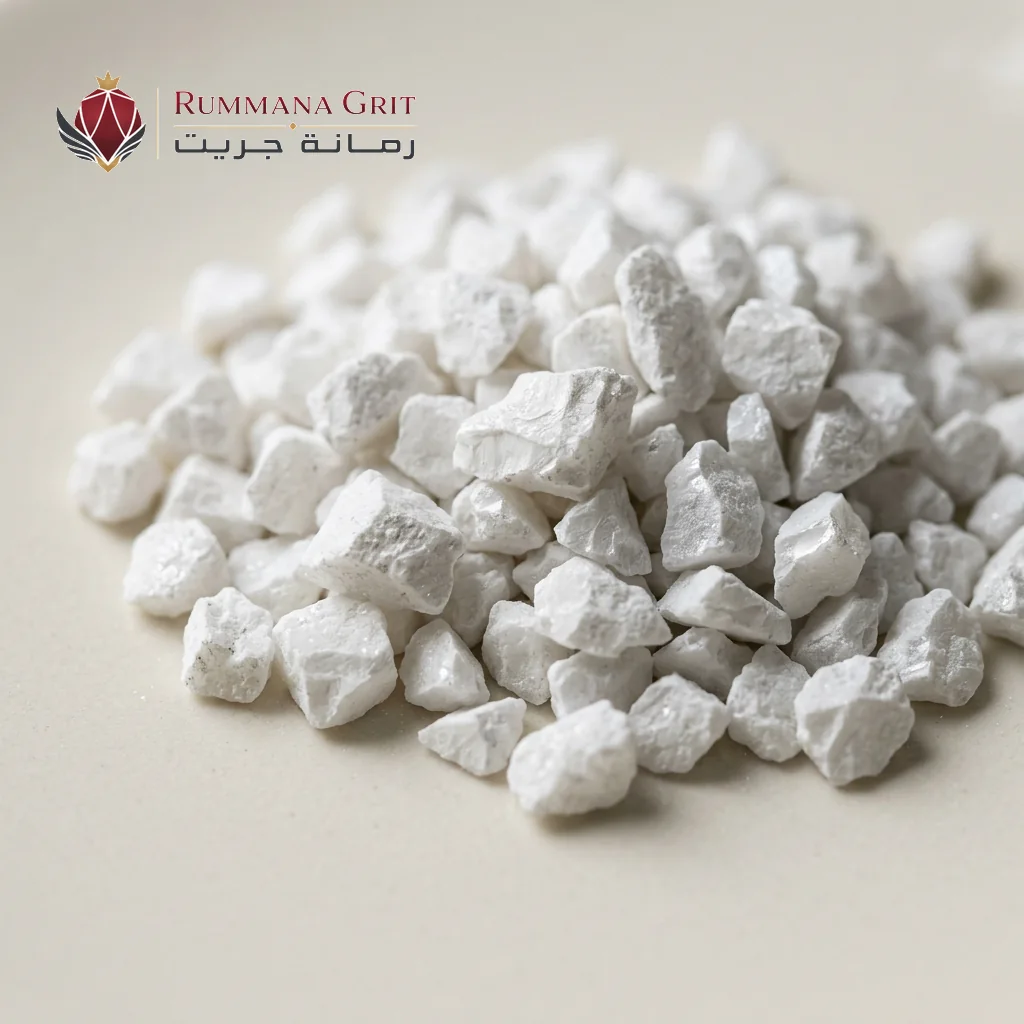
Rummana Grit white fused alumina selection starts with the required finish and grade-specific evidence. A higher-purity, more friable alumina grain. It breaks to expose fresh edges, suiting cool-cutting precision grinding and clean finishing.
- Scope
- 12#–600#
- Systems
- F / P
- Character
- Friable
Grading scope
| Band | Catalogue grit numbers | Typical system | Typical use |
|---|---|---|---|
| Coarse | 12#, 14#, 16#, 20#, 22#, 24# | F (bonded) or blasting distribution | Heavy stock removal, coarse blasting, refractory aggregate where applicable |
| Medium | 30#, 36#, 40#, 46#, 54#, 60#, 70#, 80# | F or P | General grinding wheels, belts, surface preparation blasting |
| Fine | 90#, 100#, 120#, 150#, 180#, 220# | F or P | Finishing, fine blasting, coated abrasive finishing grades |
| Micro | 240#, 280#, 320#, 360#, 400#, 500#, 600# | F micro-grits or P micro-grits | Lapping, polishing, fine coated abrasive grades |
Note. Listed grit numbers are the catalogue scope. Not every number is stocked; F and P values are not equivalent.
Technical property qualification
| Property | Published value | Qualification route |
|---|---|---|
| Al₂O₃ and Na₂O chemistry | Not published | Lot chemical analysis |
| Grain size distribution | F or P grit number | Test per the agreed system |
| Density | Not published | Measured with method stated |
| Whiteness and contamination | Not published | Agreed visual or instrumental check |
Applications
Consider Rummana Grit white fused alumina where the process calls for this grain type, then qualify the lot chemistry, distribution and finish. Colour does not certify freedom from contamination.
- Vitrified wheels for tool and hardened steel grinding
- Fine coated abrasives
- Blasting where iron contamination or dark residue is unwanted
- Refractory aggregate: a distinct application with its own grading
Limitations and what is not claimed
- Grit numbers in F and P systems describe different size distributions. They are not exact millimetre sizes and are not interchangeable.
- The grading scope shows what can be quoted, not what is held in stock. Availability is confirmed per enquiry.
- Numerical chemistry is not published here because it was not supplied in a form we can stand behind. Request a lot analysis.
- Density figures in source material had an ambiguous basis and units, so none are stated.
- No percentage performance improvement over other abrasives is claimed.
Next step: send your grade, quantity and required evidence through the contact page.
Reference standards
Reference standards: FEPA F grits are used for bonded abrasives (see ISO 8486); FEPA P grits are used for coated abrasives (see ISO 6344). Blasting grades are best specified by the agreed size distribution and process conditions rather than by grit number alone.
Standards bodies: SAE International, ISO, FEPA