
Steel abrasives
Carbon steel cut wire
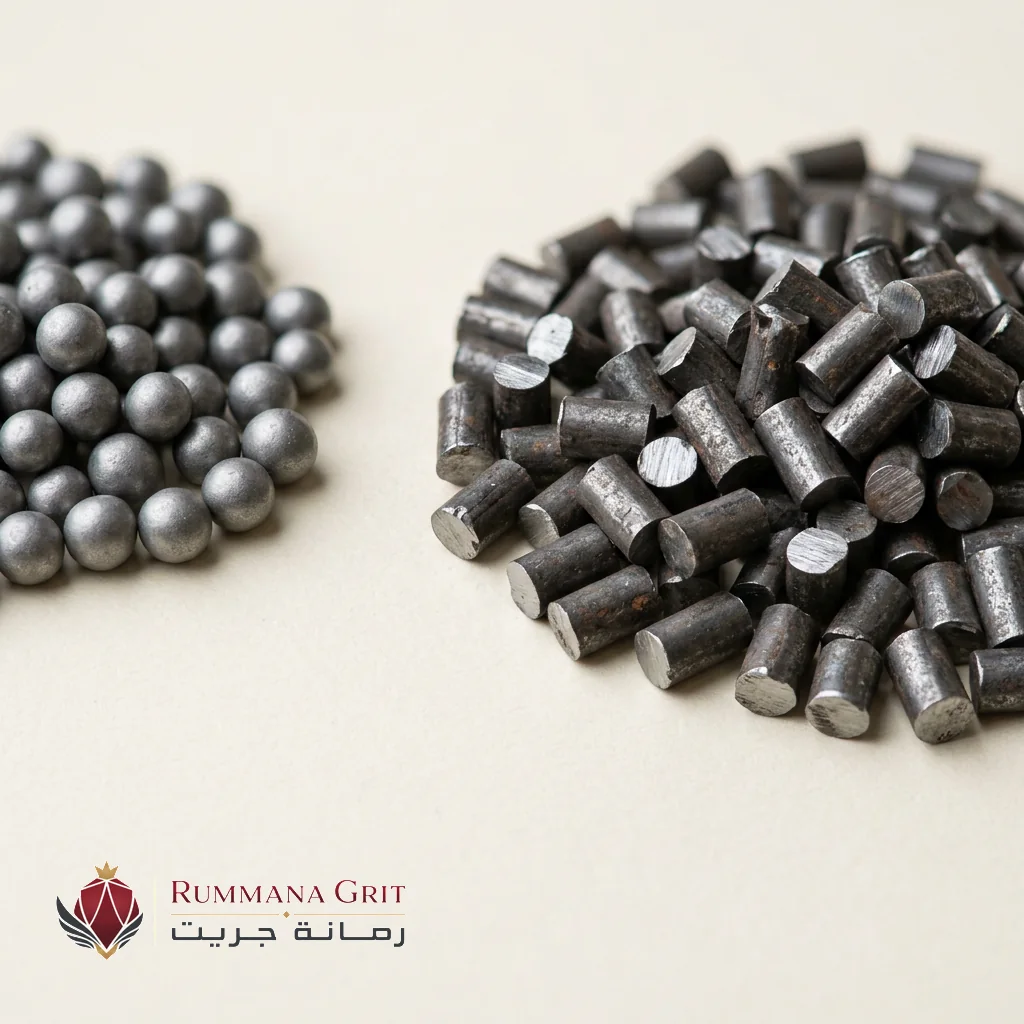
Choose Rummana Grit carbon steel cut wire by diameter and conditioning, not size alone. Cylinders cut from drawn carbon steel wire. Supplied as-cut, with sharp edges, or conditioned to round the edges. Material properties are qualified per batch.
- Shape
- As-cut or conditioned
- Sizes
- CW0.4–CW2.0
- Properties
- Batch qualification
Size chart
| Grade | Nominal wire diameter (mm) |
|---|---|
| CW0.4 | 0.4 |
| CW0.6 | 0.6 |
| CW0.8 | 0.8 |
| CW1.0 | 1.0 |
| CW1.2 | 1.2 |
| CW1.5 | 1.5 |
| CW2.0 | 2.0 |
As-cut versus conditioned
| Form | Particle shape | Typical role | Note |
|---|---|---|---|
| As-cut | Cylinder with sharp edges | Aggressive cleaning and deburring | Corresponds to the virgin unconditioned scope of ISO 11124-5 |
| Conditioned | Edges rounded by pre-treatment | Peening and finishing where a round impact is required | Degree of conditioning to be agreed and evidenced |
Chemistry, hardness, density and microstructure
None of these properties is published for this product. They depend on the wire used and must be confirmed by batch qualification reports before process approval.
Process and equipment
Rummana Grit carbon steel cut wire selection depends on whether the operation needs as-cut edges or conditioned media. Do not treat an as-cut cleaning product as qualified peening media.
- Wheel blast and air blast machines with recovery
- Peening of aluminium and steel parts, with conditioned media and qualification
Use cases
- Deburring and cleaning die castings
- Peening components where long media life is wanted
- Cleaning non-ferrous castings (stainless wire required where iron is a concern)
Quality control evidence to request
Catalogue figures describe a product family. They do not demonstrate that a particular lot conforms to any standard. For each shipment, agree the evidence before order confirmation.
| Property | Evidence to request | Why it matters |
|---|---|---|
| Size distribution | Sieve analysis report against the agreed designation (SAE J444 or the catalogue size) | Controls coverage, profile and machine loading |
| Hardness | Microhardness or HRC conversion results with sample count | Governs breakdown rate and profile |
| Chemistry | Heat or lot chemical analysis | Confirms material class and S/P limits |
| Microstructure | Metallographic section image and description | Distinguishes tempered martensite, bainite or as-cut structure |
| Shape and defects | Shape count: voids, cracks, elongated or non-conforming particles | Affects consumption and finish consistency |
| Density | Measured apparent density method and result | Verifies material and detects porosity |
Next step: send your grade, quantity and required evidence through the contact page.
Packaging
Packaging format, labelling and pallet configuration are confirmed per order. Typical options for steel media are small sacks on pallets or bulk bags sized for the handling equipment at the receiving plant. Each package should carry the grade designation, the sizing system used, and a lot number traceable to the QC evidence above.

Reference standards
Reference standards: SAE J444 describes cast shot and grit size designations; ISO 11124-3 covers high-carbon cast steel shot and grit; ISO 11124-4 covers low-carbon cast steel shot; ISO 11124-5 covers cut steel wire. Citing these standards here is for orientation only and does not indicate certification.
Standards bodies: SAE International, ISO, FEPA